I am conducting research in human-computer interaction (HCI) at NYU Tandon School of Engineering. My path to doctoral research was shaped by formative years at Yale-NUS College in Singapore, followed by work in venture capital and early-stage startups. Within an industry defined by the rapid turnover of ideas and continual chase for the next big thing, I found myself most energized by deeper questions underlying how technologies shape human thinking and experience.
It might help to break down the acronym “HCI”. Human. Computer. Interaction.
While a social scientist might be interested in studying the “Human” part, and a computer scientist in the “Computer” part, a HCI researcher focuses on the two-way communication between man and machine. You’d need to know quite a bit about humans (how humans think, feel, behave) and also about various technicalities (tech systems, devices, frameworks, interaction styles, etc.).
Now, imagine that you are asked to fly this plane.
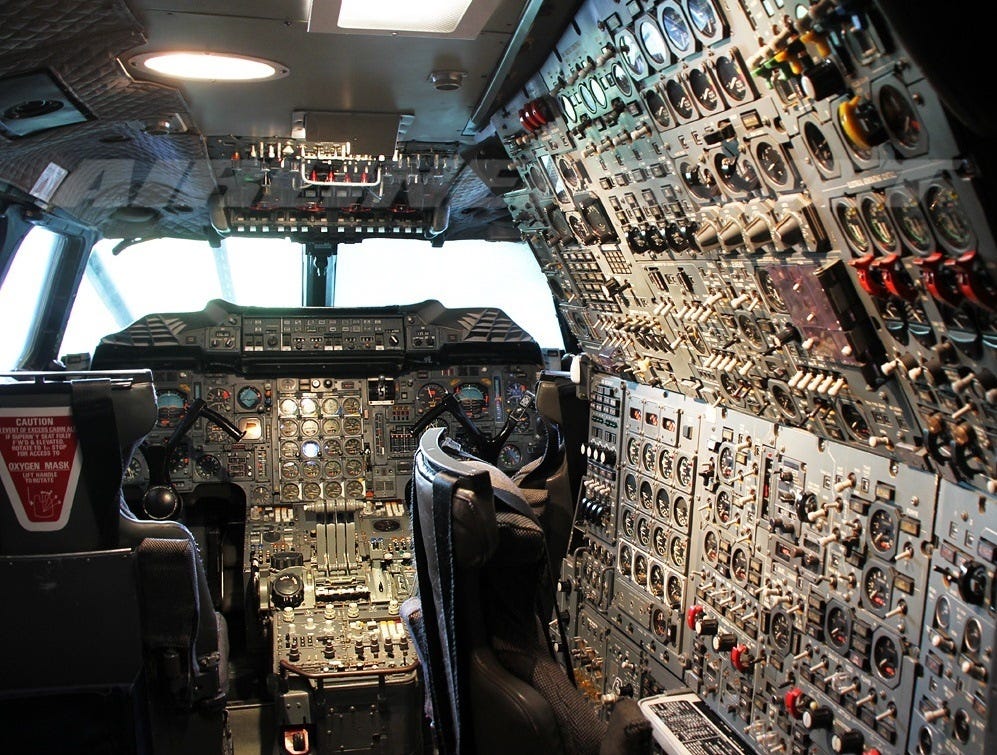
It sure looks overwhelming. While pilots are trained to operate this, they too may be prone to errors, balancing several tasks all at once, confusing its knobs, faders and indicators. The HCI researcher might ask – how can we redesign/reengineer this to help a pilot do their job better? How do we also help humans communicate more effectively with this piece of machinery, and vice-versa? How do we enhance seamlessness, intuitiveness and most importantly, safety? It is also vital to balance human needs with technological possibilities. In other words, some ideas might be perfect but not technologically viable.
The above case and line of questioning is just a relatively simplistic example. It’s exciting to know that HCI research spans all topics possible — Privacy and security network for banks, textiles fabrication via 3D printing, autonomous driving vehicles, natural language processing (a branch of AI) to study social media content…you name it.
I read somewhere that “Curiosity is for knowledge what hunger is for food”. The curious learner is self-motivated, creative, and resourceful. Curiosity actually arises from uncertainty (a rather uncomfortable feeling)! When we realise that we lack desired knowledge, we become curious and feel compelled to uncover missing information. In this vein, when educators present information in a way that makes ‘information gaps’ salient, we encourage learners to seek out more.
One technique could be to reveal enough of a puzzle/topic, but also leaving salient information gaps that compels children to ask about it, or explore as a means of filling the knowledge gap. A teacher can also weave coding education with narratives or storytelling to rouse curiosity, or pose challenging questions that encourage students to seek answers in their own unique way.
There is a fine line between understimulation and overstimulation. When the content lacks sufficient novelty or complexity, children end up bored and would rather do something else. When overstimulated or overloaded with information, students may disengage (e.g. daydream) to reduce their level of arousal. They may be discouraged and give up. An observant teacher would be able to identify and cater to this, finding the sweet spot for each child’s optimal learning.
In today’s highly digitalised world of education, I’m a fan of learning platforms with adaptive feedback systems. These coding platforms provide just-in-time feedback for learners just like a real teacher might. They may have dynamic features, such as automatically adapting the difficulty level according to students’ behaviour and understanding level. These tech platforms can supplement educational journeys in very real ways, especially given the shortage of educators and lack of access some students face.
HCI pulls together methods and insights from many disciplines, to inform the design and development of technology. The intersection between HCI and education is a broad one, but here are some established areas of research that I personally find fascinating:
At The Young Maker, this research directly informs how we design our Coding & Robotics classes for kids and teens. Our goal is not just to teach children how to use technology, but to help them understand how technology works and how to think critically when working with intelligent systems.
You can visit my website feliciatan.co