Coding Olympics 2026: Top 20 for The Young Maker
Hosea Lee placed in the Top 20 of Category B at Coding Olympics 2026. Here is how the competition actually works — the categories, the format, the scoring — and how The Young Maker prepares students for it.
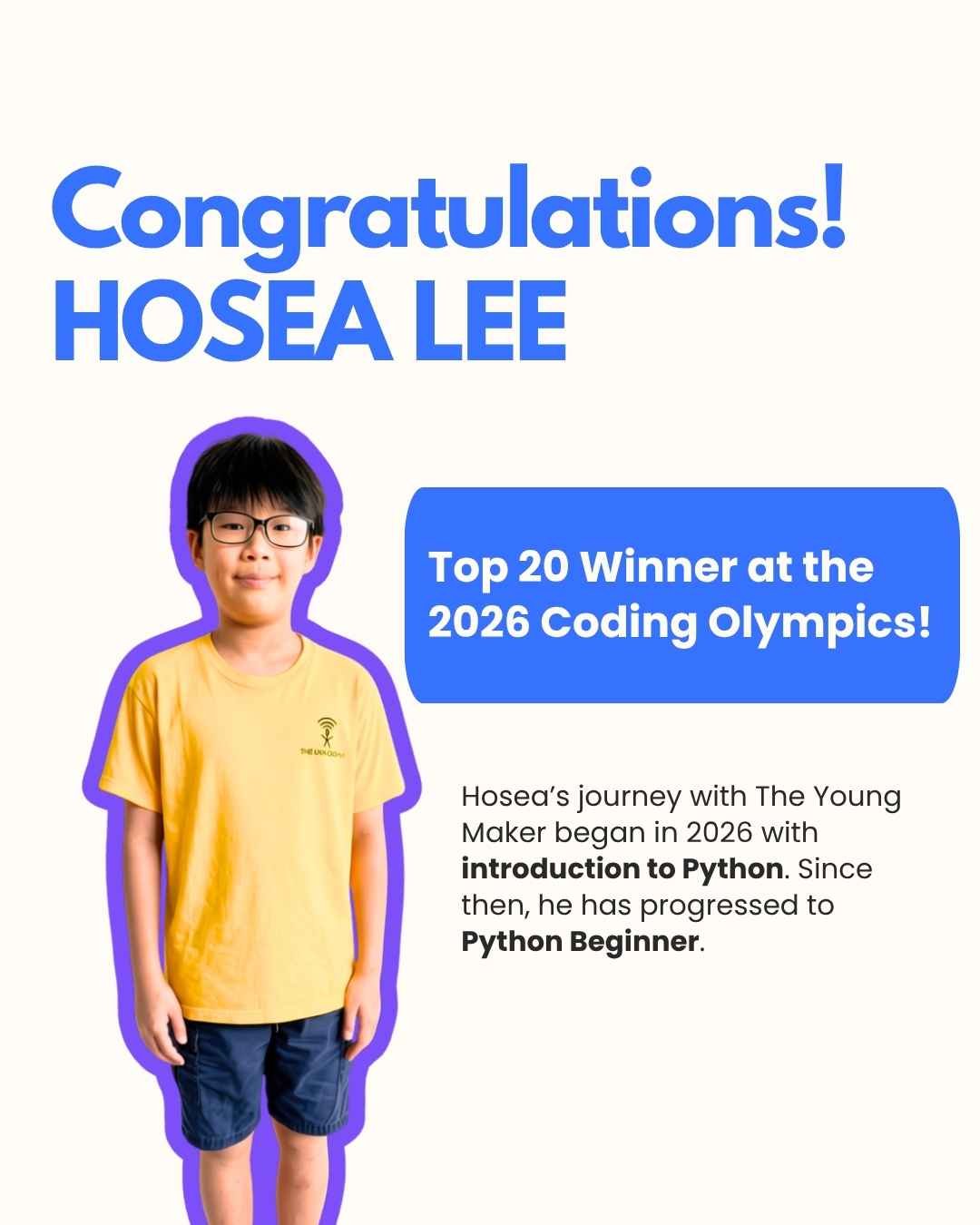
One of our Young Makers, Hosea Lee, has placed in the Top 20 of Category B at Coding Olympics 2026 — a global field that this season drew young coders from China, Thailand, Vietnam, the Philippines, Indonesia, Taiwan, Cambodia, Myanmar, Nepal and Singapore.
What is it? Which category does my child belong in? How is it actually scored? Here is the Coding Olympics 2026 guide, drawn from the organisers' official 2026 handbook.
What is Coding Olympics Singapore?
Coding Olympics 2026 — COS2026 — is a global coding competition for primary school students, jointly organised by Singapore Science Centre Global and mangoSTEEMS Singapore. The 2026 edition was its sixth year.
Coding Olympics categories: A, B and C
Participants are grouped by school level:
- Category A — Primary 3 and 4, ages 9 to 10
- Category B — Primary 5 and 6, ages 11 to 12
- Category C — Primary 2, age 8. Non-competitive; participants join the live coding lessons only
How Coding Olympics is scored: the three stars
Scoring is automated by the platform. Each challenge is worth up to three stars, and the total is counted over a 60-minute window with one attempt only.
What each star is awarded for
- The first star — the challenge is solved. The code works.
- The second star — the child applied the specific coding concept that challenge was built to teach, rather than reaching the answer some other way.
- The third star — the code is short and to the point.
No stars are awarded if the code fails to solve the challenge.
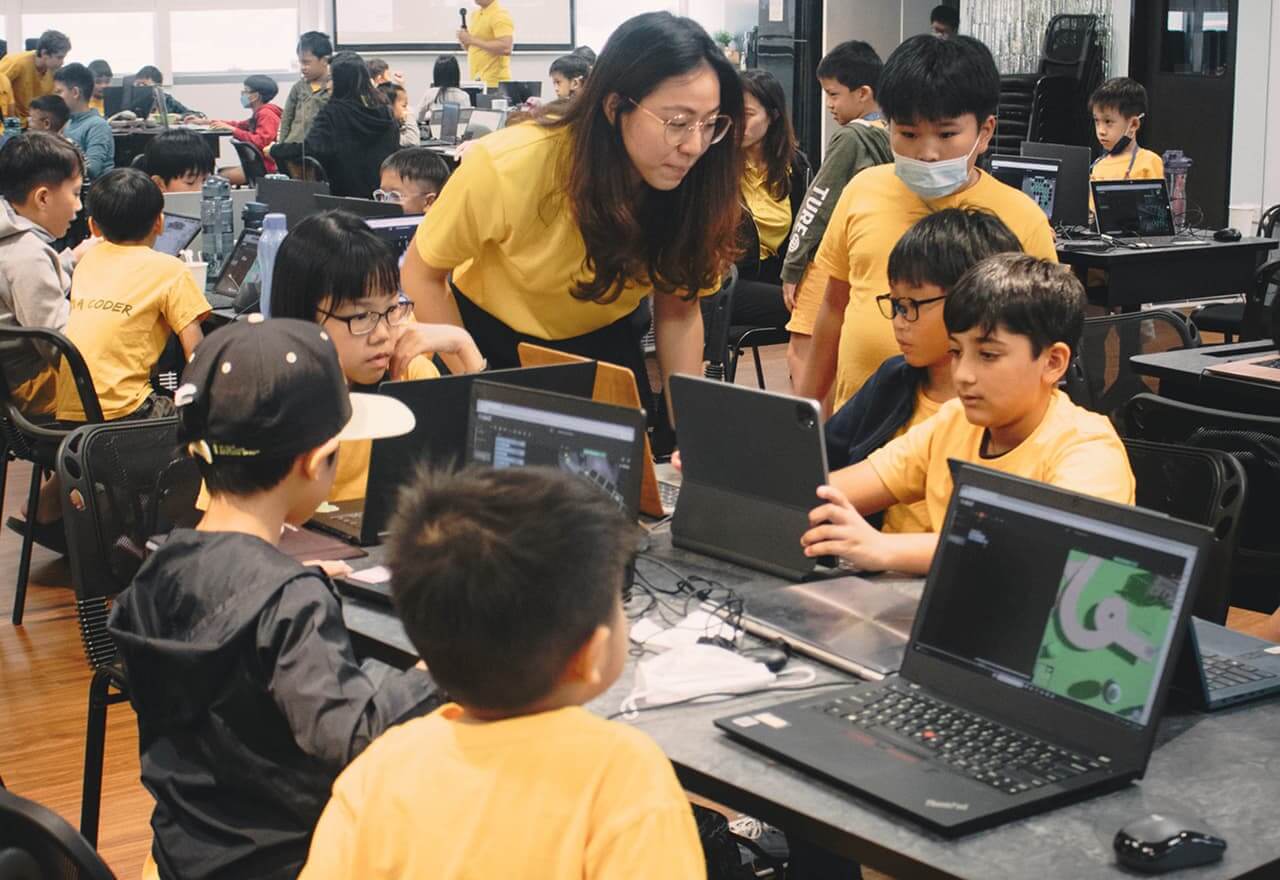
How The Young Maker prepares students for Coding Olympics 2026
Our courses put Young Makers in front of real code early and keep them there. They learn to:
- Write, run and read actual code rather than assembling pre-made pieces
- Use variables, conditions, loops and functions with intent, understanding why each is the right tool for the job
- Read an error message and treat it as information rather than failure
- Test their own work — try it, watch it break, work out why, fix it, try again
- Sit with a hard problem long enough to solve it
Frequently asked questions
What is Coding Olympics Singapore?
Coding Olympics is a global online coding competition for primary school students, jointly organised by Singapore Science Centre Global and mangoSTEEMS Singapore. The 2026 edition ran from 28 July to 2 August and was its sixth year. It is held on CodeMonkey, where students write CoffeeScript.
What are the Coding Olympics categories?
There are three. Category A is for Primary 3 and 4 students aged 9 to 10. Category B is for Primary 5 and 6 students aged 11 to 12. Category C is for Primary 2 students aged 8 and is non-competitive, with participants joining the live coding lessons only.
Does my child need coding experience to enter Coding Olympics?
No. The organisers state that no prior coding experience is required, and the competition opens with four days of free live online lessons covering coding fundamentals and over 105 practice challenges. Experience does matter for placing well, however, because the second and third stars reward genuine understanding of programming concepts rather than trial and error.
Well done, Hosea
Congratulations to Hosea on a Top 20 finish in Category B, and to every young learner who took part this season.
If you would like to see how we teach the same thinking through hardware, our write-up on hands-on robotics projects for kids covers the maker side of it.
Interested in enrolling your child?
The Young Maker teaches coding, robotics and AI to young learners in Singapore — real code from the first lesson. Book a trial class and start your child's journey.
Book a trial class