Coding & Sustainability at Greendale Primary School
Upper primary students built motion-controlled games and IoT sustainability prototypes — applying computational thinking and block-based coding to real-world challenges aligned with Singapore’s Green Plan 2030.
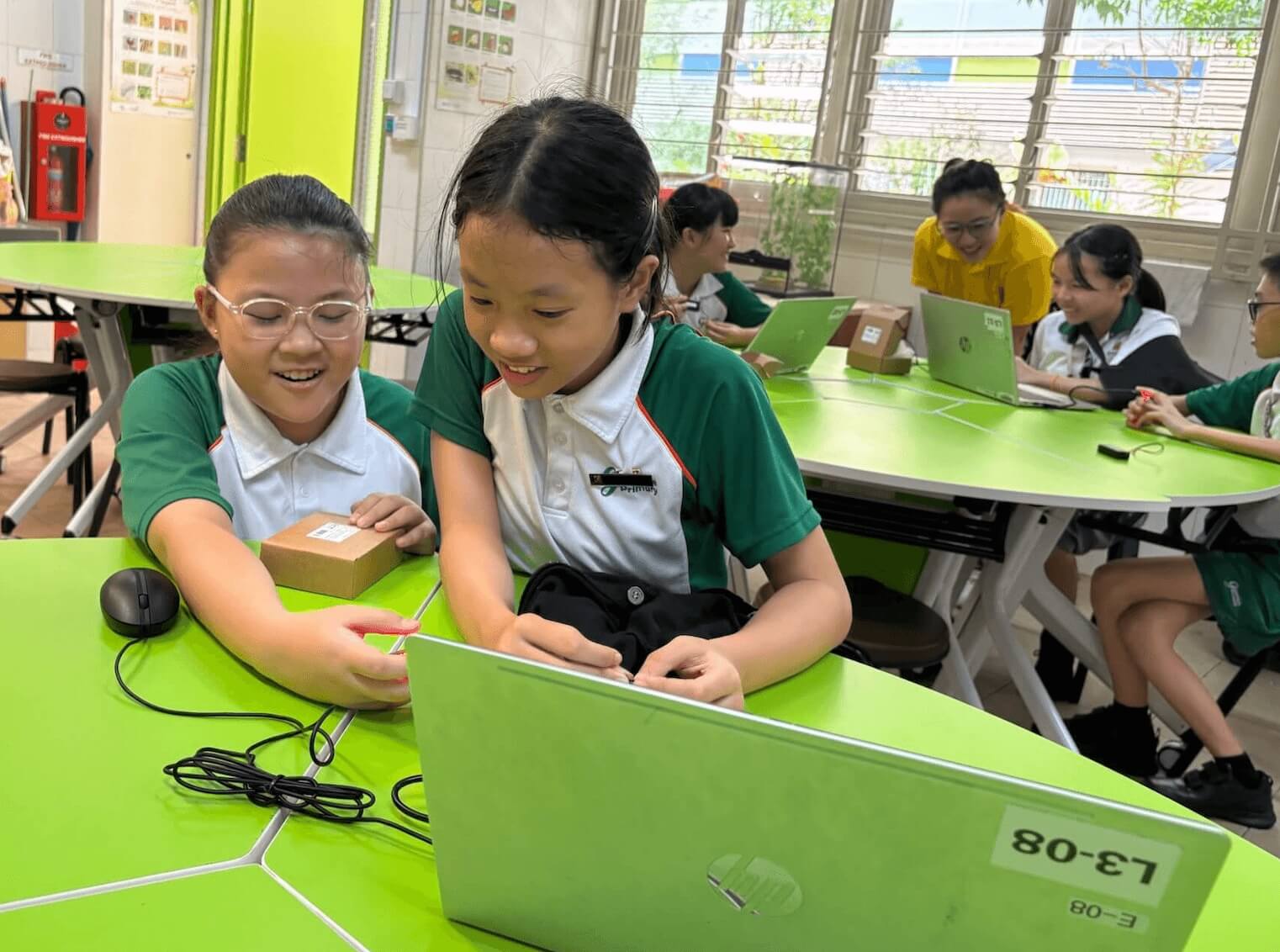
When students write code that controls a physical device — or build a game their classmates actually want to play — something clicks. The skills feel real because the outcome is real.
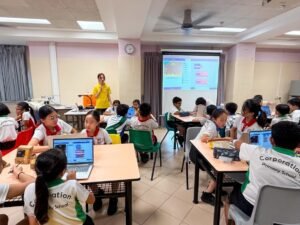
The Young Maker worked with Greendale Primary School to deliver two programmes built for upper primary students who are new to coding and ready to make something from the ground up. Both are grounded in Singapore’s push to equip every student with computational thinking, coding, and digital literacy skills — and tied directly to the nation’s Green Plan 2030 sustainability goals.
Scratch: Environmental Games
Upper primary students designed and built their own interactive, motion-controlled game using Scratch’s block-based coding environment. Using the computer’s camera as a live controller, players physically interacted with the screen — an early bridge between virtual design and AI sensing concepts.
The project had a deliberate environmental sustainability theme. Students didn’t just learn to programme — they designed a game with a purpose, making every decision about how their game educates and engages players on real-world issues.
Block-Based Coding
Students used Scratch’s event-driven environment to build a complete, playable game from concept to launch.
Motion Sensing
The computer camera detected real-world gestures as in-game inputs — an early taste of AI and AR concepts.
Full Game Design
Every student shipped a complete game: title screen, live gameplay, scoring system, and end screen.
Sustainability Theme
Environmental awareness was woven into every mechanic — giving students a reason to care about what they built.
Skills Developed
Sequences & event-driven coding · Loops & conditionals · Variables & score tracking · Sprite cloning & game logic · Motion sensing / camera input · Creative problem solving
Programme Outcome
Every student completed this programme with a fully working, playable Scratch game — from title screen to gameplay to end screen — that they designed, coded, and debugged themselves. They left with core computational thinking vocabulary and the confidence to iterate on their own code.
Micro:bit: Smart Plant Helper
This programme moved coding off the screen entirely. Upper primary students used a BBC Micro:bit — the microcontroller at the heart of Singapore’s Digital Maker Programme — to build a working Smart Plant monitoring system that reads live sensor data and responds automatically to environmental conditions.
The project was anchored directly in Singapore’s “30 by 30” food sustainability goal — the national target to produce 30% of local nutritional needs by 2030 through urban farming and technology. Students weren’t studying this as a topic. They were building technology to help solve it.
Physical Computing
Students wired sensors and programmed hardware — crossing from coding into engineering.
Sensor Data
Real analog inputs (soil, light, temperature) drove real outputs — feedback icons and alerts on the device.
Wireless Communication
Students used the Micro:bit’s radio feature to send and receive data wirelessly between devices.
Urban Farming Context
The Singapore 30 by 30 food goal gave students a genuine reason to care about the technology they were building.
Skills Developed
Physical computing & hardware integration · Sensor data & analog inputs · Conditionals & threshold logic · Variables & real-time data · Wireless communication · IoT & Smart City concepts
Programme Outcome
Students completed this programme with a working, tested IoT prototype that responds to real environmental sensor data. They applied systematic debugging, peer review, and iterative refinement — skills that mirror Singapore’s Applied Learning Programme (ALP) competencies for STEM education.
Trusted by Schools Across Singapore
The Young Maker has delivered coding enrichment programmes across primary and secondary schools in Singapore since 2020. Our instructors are experienced in BBC Micro:bit, Scratch, AI literacy, and digital making for students aged 7 to 18.
Bring a Coding Programme to Your School
The Young Maker delivers MOE-aligned coding enrichment programmes for primary schools across Singapore — from Scratch and Micro:bit to AI literacy and coding. We customise every programme to your school’s goals, level, and curriculum needs.
Get in Touch